
Good physical conditioning of a football team is reflected in the players’ ability to perform all technical and tactical tasks at an optimal intensity throughout the entire match (90–120 minutes).
In moments of physical or mental fatigue, proper conditioning allows the player to continue demonstrating technical and tactical skills — and matches are often decided in the final minutes.
As one of the most demanding sports in terms of motor endurance, football requires a strong aerobic foundation, since the game consists of repeated short and explosive actions over an extended period.
Understanding the physical demands of a match is essential for creating an appropriate training program. During a single match, professional players cover between 10 and 13 km, performing around 1,400 activity changes — roughly one every 4 seconds.
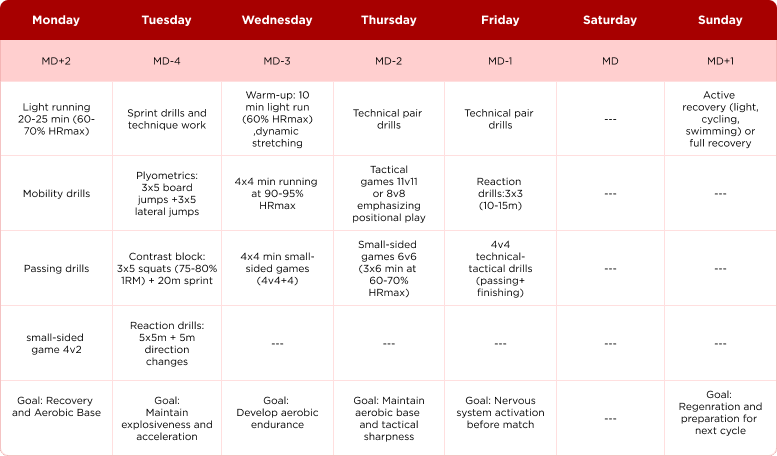
The weekly training cycle of football players during the competitive period is designed with respect to the number and importance of matches played that week.
If there are two matches or one important match, lower training loads are applied.
In weeks with less demanding matches, the training load increases, allowing players to accumulate training effects that should lead to improved form in the following cycles.
Aerobic training aims to improve the power and capacity of the aerobic energy systems and is divided into low, moderate, and high intensity based on heart rate.
High-intensity aerobic training involves intervals above 90% of maximum heart rate (HRmax).
When the goal is to improve the player’s ability to run long distances at high intensity and recover between intense actions, high-intensity aerobic work represents the minimum level of intensity required during intensive training phases.
Typical intervals last 1–4 minutes, followed by recovery shorter than the work period — for example, 2 minutes of work followed by 1 minute of rest.
Depending on the format and rules, high-intensity aerobic training can be implemented through small-sided games, still achieving heart rates above 90% HRmax.
However, the variable nature of football makes these games highly demanding on both aerobic and anaerobic energy systems.
If the goal is to maximize pure aerobic capacity, small-sided games have inherent limitations compared to more controlled drills.
Rules and pitch dimensions can be adjusted to reduce the number of intense situations (such as sprints or 1v1 duels) by adding “joker” players or restricting the number of ball touches, but overall internal and external load cannot be completely standardized.
Examples of Aerobic Exercises
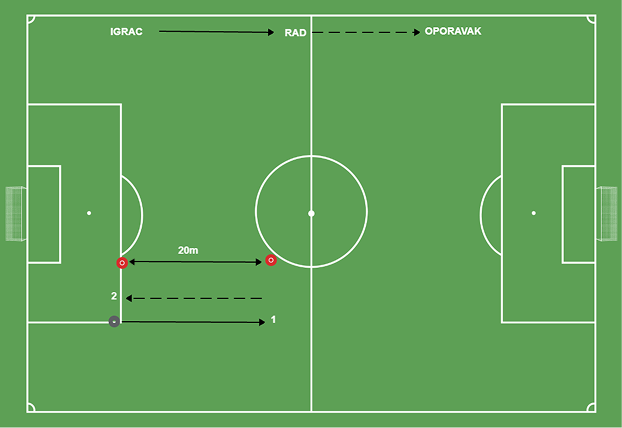
Exercise 1 – Aerobic Run Intervals
Intensity: High
Duration: 4 minutes
% of Max HR: 85–90%
Work-to-Rest Ratio: 1:2
Distance Covered: 720 m
Description:
Each run is performed at a consistently high level.
Each high-intensity repetition should last about 20 seconds, followed by 40 seconds of recovery.
One set includes four repetitions, with a total of 528 m of high-intensity running and 192 m of low-intensity running.
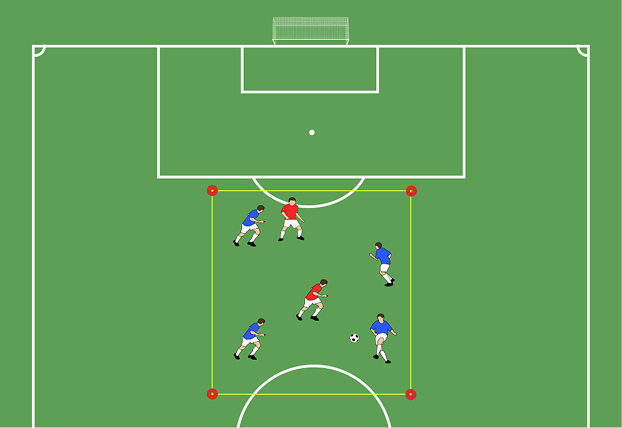
Small-Sided Game 4v2
The 4v2 possession game is designed to maintain ball possession within a 12×12 m area.
There are four attackers and two defenders.
The goal of the attackers is to pass the ball between themselves and keep possession, while the defenders attempt to intercept passes.
A key principle is that the player in possession should always have two passing options — to the right and left — with teammates adjusting their position accordingly.
When defenders touch the ball, they switch roles with the attackers.
You can also set a limit of one or two touches per player to increase difficulty.
Moderate-Intensity Aerobic Drill with the Ball
Description:
This drill can be performed across the full width or half of the pitch, and it can be done individually or in small groups.
Each bout should last 3 minutes at 70% intensity, repeated four times.
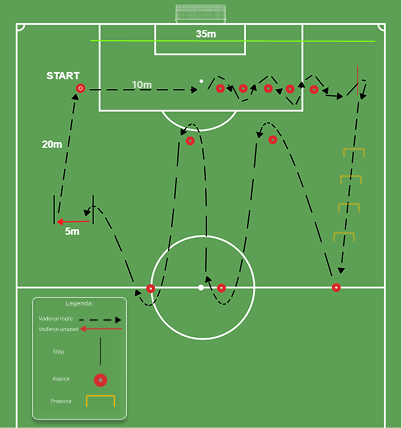
Example of an Aerobic Circuit
Work-to-Rest Ratio: 4 minutes work – 4 minutes rest
Organization:
The player must dribble through red cones, pass through yellow gates, circle blue cones, and finish with a shot on goal.
Recommendations:
Players should work at maximum effort throughout the exercise.
The ratio of work to rest is 1:1, so a player working for 4 minutes should rest for 4 minutes.
Each player should complete 6–10 repetitions.
To further improve conditioning, the rest time can be shortened between repetitions, or a defender can replace the blue cones to apply active pressure on the working player.
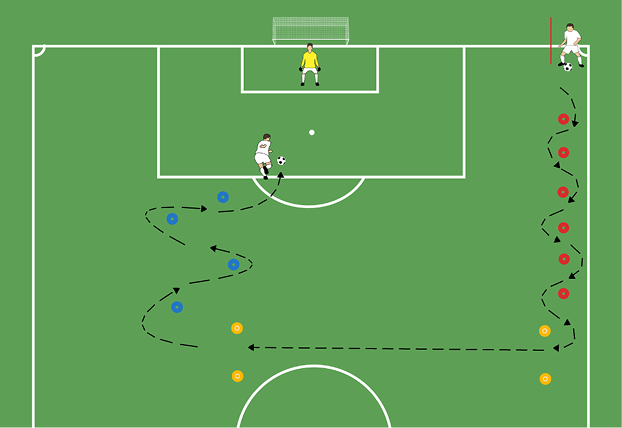
Example of Aerobic Drill with Technical Component (Dribbling + Shooting)
Work Period: 4 minutes at 95% HR
Rest Period: 3 minutes
Organization:
The player starts on the left sideline, dribbles through yellow gates toward the red cones, runs over small hurdles (pushing the ball past or under), dribbles around blue cones, and finishes with a shot on goal.
Recommendations:
Players should work at maximum effort throughout.
Each 4-minute work period is followed by 3 minutes of rest.
Each player performs 6–10 repetitions.
It is essential that players reach and maintain 90–95% of their heart rate during the work phase, and that heart rate drops to around 70% during recovery.
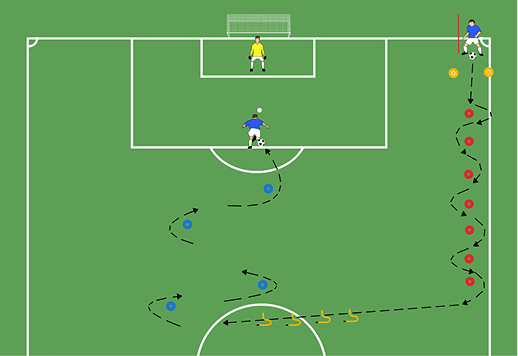
Example of an Aerobic Circuit with the Ball
This setup combines dribbling, agility, and finishing, allowing players to sustain aerobic output while incorporating ball control and technical actions.
Possession Game 8v4
Three teams of four players compete within a 25×15 m grid. The yellow team positions along the edges,the blue team is attacking and in possession,the red team defends. The blue and yellow teams cooperate to maintain possession, while the red team attempts to regain the ball. Yellow players play one-touch passes, while all players stay constantly in motion.
Key Points:
Focus on first touch, positioning, and passing accuracy.
Shift the focus of play to the less-covered area of the grid.
The defending team changes after 90 seconds.
This game efficiently develops aerobic capacity under tactical conditions.
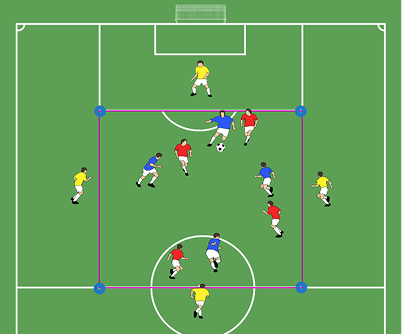
Weekly Training Schedule (Competitive Period)