Mistake No. 2: Copying Methods and Content Inappropriate for Young Athletes
Young athletes cannot be considered miniature adults. Therefore, applying methods and content used by adults, especially elite athletes, is not only inappropriate but also dangerous.
Inappropriate training with young athletes is most often reflected in excessive volume (number of weekly training sessions, length of individual sessions, excessive number of exercises within a session) or intensity (excessive loads, insufficient rest between repetitions, etc.).
If young athletes lack strength, endurance, flexibility, or do not possess proper technique for performing specific exercises, numerous problems may arise, often leading to sports-related injuries.
A simple, yet unfortunately common example is assigning a large number of push-ups during training, without considering that many young athletes do not yet have sufficiently developed musculature, especially core strength, to withstand such loads. Possible consequences include lumbar lordosis and hand joint injuries.
A more drastic example is assigning the “suicide” exercise, which young athletes must complete within a set time (e.g., 30 seconds). If they fail, they may be required to repeat the exercise or even be held responsible for the entire team’s repetition. In doing so, coaches often overlook the fact that young athletes, due to their immature glycolytic anaerobic capacity, are not prepared for anaerobic efforts longer than 15 seconds before the age of 16. The result may be fatigue, vomiting, and loss of motivation.
Young athletes often set very high goals for themselves. According to Dr. Maffulli from Scotland, this is especially evident in athletes who do not compete at the highest level but train with great intensity in pursuit of elite standards.
By using methods and content designed for adults, especially elite athletes, short-term success can be achieved by accelerating development. However, this approach ignores the fact that a young athlete’s body is still growing and developing, and that their emotional maturity does not match that of adults. This can lead to injuries, exhaustion, loss of motivation, and, unfortunately, withdrawal from sport.
How to Avoid the Second Mistake
At first glance, the simplest solution may seem to be reducing the volume and intensity used in adult training. However, the daily physical, cognitive, and emotional changes that occur in growing athletes require a more comprehensive approach.
Training methods and content must be adapted to the stages of athletic development.
Understanding the characteristics of each stage allows coaches to plan optimal, progressive, and long-term development of motor abilities and skills. This provides young athletes with a strong foundation for future success in sport.
Stage ATHLETICO (Ages 10–14)
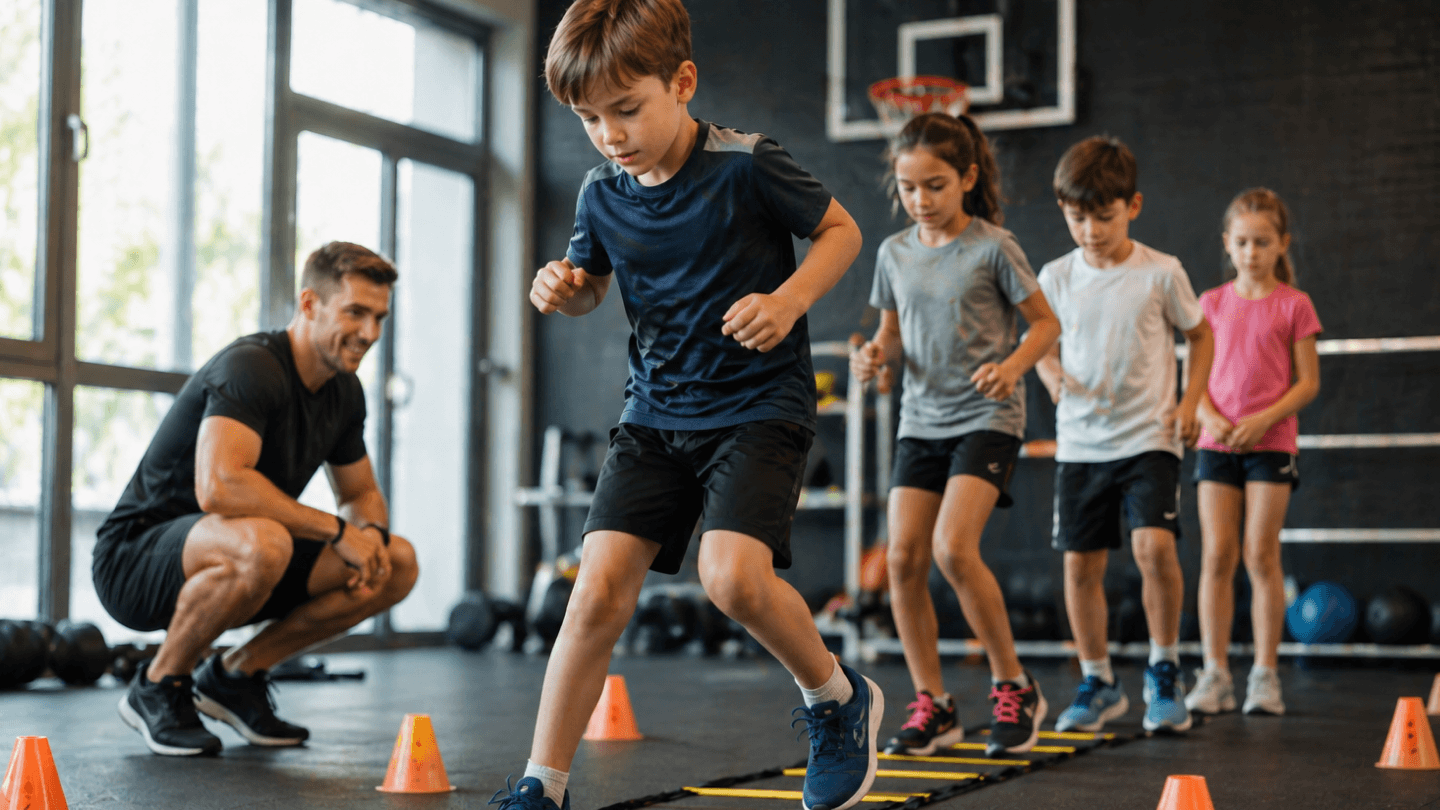
For young athletes aged 10–14, whose stage of development we have named ATHLETICO, it is essential to focus on fundamental movements:
- Proper running (sagittal and frontal planes)
- Running with changes of direction
- Jumping and landing
During this stage, it is not advisable to introduce sharp changes of direction or excessively high jumps, as these may hinder the acquisition of proper technique.
Toward the end of this stage, sport-specific movements can be introduced—but still with a strong emphasis on correct technique.
Deficiencies in movement technique are difficult to correct later. Exercises should serve as tools for learning, not the ultimate goal of training.
Understanding each stage of development is essential for designing effective and appropriate training.
Key Principle
In their first of 12 basic principles for creating young and healthy athletes, Avery D. Faigenbaum and Larry Meadors state:
“Regardless of how big, strong, or coordinated a young athlete may be, the youth sports coach must recognize that children and adolescents are still growing, developing, and maturing. Therefore, young athletes require a specific approach to physical preparation for sports participation.
What constitutes an appropriate program for young athletes is determined by their neuromuscular training, control of proper body posture, movement mechanics, psycho-social maturity, and physical development.
Programs and training philosophies for adults (e.g., ‘no pain, no gain’) should not be applied to youths who are physically and psychologically less mature than the older population.”
Wishing you success,
Igor Macner
Co-founder of Mozaiq Sports
Referenzen:
Faigenbaum, A., Meadors, L. (2012). „A Coaches Dozen: 12 FUNdamental Principles for Building Young and Healthy Athletes“, www.strong-kids.com
Maffulli, N. (2000) „At what age should a child begin regular continous exercise at moderate or high intensity?“ , University of Aberdeen