

Compensatory sessions have become a default solution in elite football. A team plays, starters recover, and the non-starters “top up” the missing load. On paper it sounds simple, the players who didn’t play should replace what they missed. Are we compensating for the match in a meaningful way, or are we simply adding work that looks hard without truly restoring match readiness? The match provides a very specific stimulus. It is not just running volume or the total time the player spent in a match. It is a mixture of sprint, high-speed actions, repeated accelerations and decelerations, and transitions. When a non-starter repeatedly misses that exposure, the problem is not only that weekly totals drop. The problem is that the player may go for weeks without touching the true match-like demands that define readiness.
This is why compensatory training is not a “nice extra.” It is a load-management strategy aimed at protecting availability and performance when squad rotation changes. The concern is that many compensatory sessions do not actually close the gap. In a study comparing compensatory sessions across three teams within the same professional club structure, the compensatory session often represented only a portion of match demands.
Across key external-load metrics, values ranged roughly from 30–90% of match output, but many variables clustered closer to the mid-range rather than truly approaching match demands (Casamichana et al., 2024). This becomes particularly relevant when we think beyond a single match. A player can often complete one full match even if their recent match exposure has been low, especially if their general fitness is good. The real risk appears when exposure increases over consecutive games. One match becomes two, then three, or the team enters a congested period with two matches per week.
At that point, players with a lower chronic exposure to match demands are more likely to struggle to tolerate repeated match loads. From a readiness perspective, the issue is not simply “they didn’t run enough last week.” It is that their recent training stimulus may not have contained enough match-like peak actions and enough chronic load to make those demands manageable.
The Relationship Between Compensation Training and Worst-Case Scenarios
In practice, it’s relatively straightforward to build a top-up session that hits the aerobic, neuromuscular and metabolic load using different methods and SSG. That’s one reason compensatory sessions can look convincing. Compensatory sessions frequently land at only around 45–65% of match demands for high-speed running and sprinting (Casamichana et al., 2024). So even the “easy” part is not guaranteed unless it is intentionally planned and protected in the session design. Where compensation becomes truly difficult is in replicating what the match uniquely provides. This is also where teams often lean on football-specific formats such as small-sided games, possession, and transition drills.
Worst-case scenario helps explain why this happens and why it matters. The WCS approach evaluates load in short rolling windows that capture the most demanding passages of play rather than relying on 90-minute averages. In Bortnik et al. (2024), the peak 30-second passages of match play (WCSpeak) highlighted clear gaps between training and match demands, particularly for high-velocity outputs and maximum deceleration actions. Even on the microcycle’s main conditioning day (MD-3), football-specific training formats often failed to replicate match peak sprint demands across positions, while acceleration and deceleration counts tended to be closer to match values.
This is a key implication for compensatory training. If non-starters are missing match exposure, and training does not reliably reproduce the match’s most intense moments, the readiness gap can persist even when weekly totals look acceptable. In other words, compensation is not only about recovering missing volume, but also about restoring exposure to the short match passages.
What to Prioritise and Monitor in Compensatory Sessions (Peak Exposures vs Volume)
Match intensity is not experienced as a steady output. It is experienced as short bursts of very high mechanical stress within a longer, lower-intensity background. This is why elite football monitoring has increasingly shifted toward analysing peak intensity periods using rolling time windows, commonly labelled as Most Intense Periods (MIPs) or Most Demanding Periods (MDPs).
Instead of asking “how much did the player do over 90 minutes,” rolling-window analysis asks, “what was the most demanding 30 seconds, 1 minute, 3 minutes, or 5 minutes the player had to tolerate.” These framing matters because the peaks are often what expose players, and the way you calculate them can change what you identify as the “peak,” depending on the window length and whether you use overlapping or non-overlapping windows (Buchheit, 2024), Figure 1.
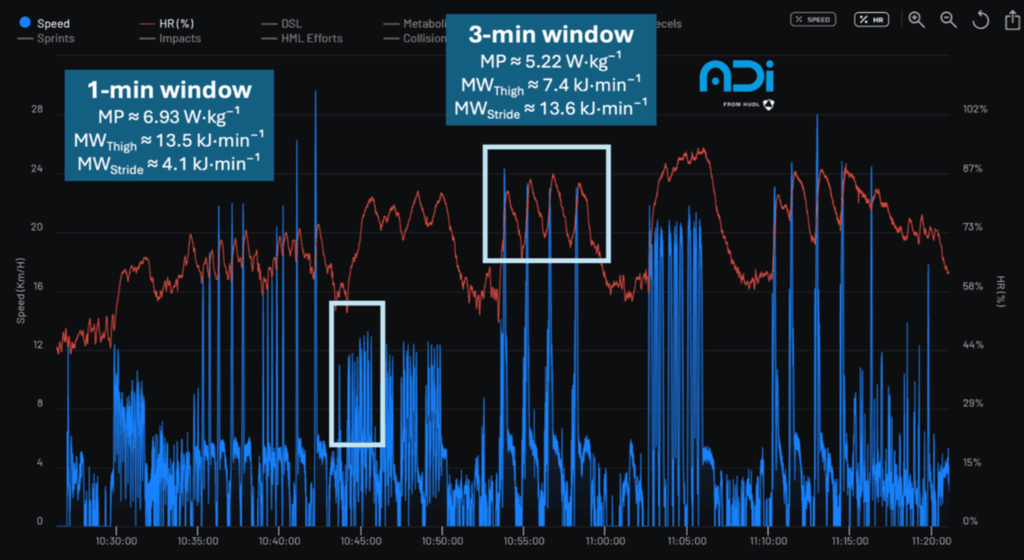
The practical relevance is that peak passages can be more informative than totals for understanding stress and risk. Work discussed in Buchheit (2024) highlights that injured players have shown greater sprint exposure in the 1-minute and 5-minute periods immediately preceding injury, even when overall match loads were not dramatically different. This helps explain why compensation is not only about recovering missing volume, but also about restoring exposure to the short, extreme match moments that define readiness.
At the same time, it is important to recognise that match derived peaks are context dependent, they do not necessarily represent true maximal locomotor capacity, but rather the highest demands encountered in a specific competitive environment. (Buchheit, 2024). Compensation works best when it is built around two complementary buckets, peak or maximal-action variables that drive match readiness, and volume variables that support work capacity and weekly completeness. When non-starters miss matches, they often miss the highest-intensity exposures that keep them prepared for sudden match involvement. That is why compensatory planning should prioritise external metrics that reflect maximal football actions, particularly high-speed running, sprinting, maximum acceleration, and maximum deceleration.
These exposures often separate “training fit” from “match ready.” They also align with worst-case scenario thinking, where the most demanding passages of match play are difficult to reproduce consistently in training, and substitutes or non-starters may miss these peak demands (Bortnik et al., 2024). Volume metrics matter because they contribute to weekly load accumulation and support the chronic-load base that protects players when exposure increases, for example when a non-starter becomes a starter during a congested period.
The logic is straightforward, if non-starters repeatedly fail to accumulate enough weekly work, their chronic exposure stays low, and the risk profile changes when they suddenly need to tolerate higher match volumes. Longitudinal work comparing starters and non-starters shows that teams who manage this well often use training to increase non-starters relative exposure, reflected in higher training-to-match ratios, in order to narrow the gap (Oliveira et al., 2023).
The ABC Decision Framework: Choosing the Right Compensation Solution
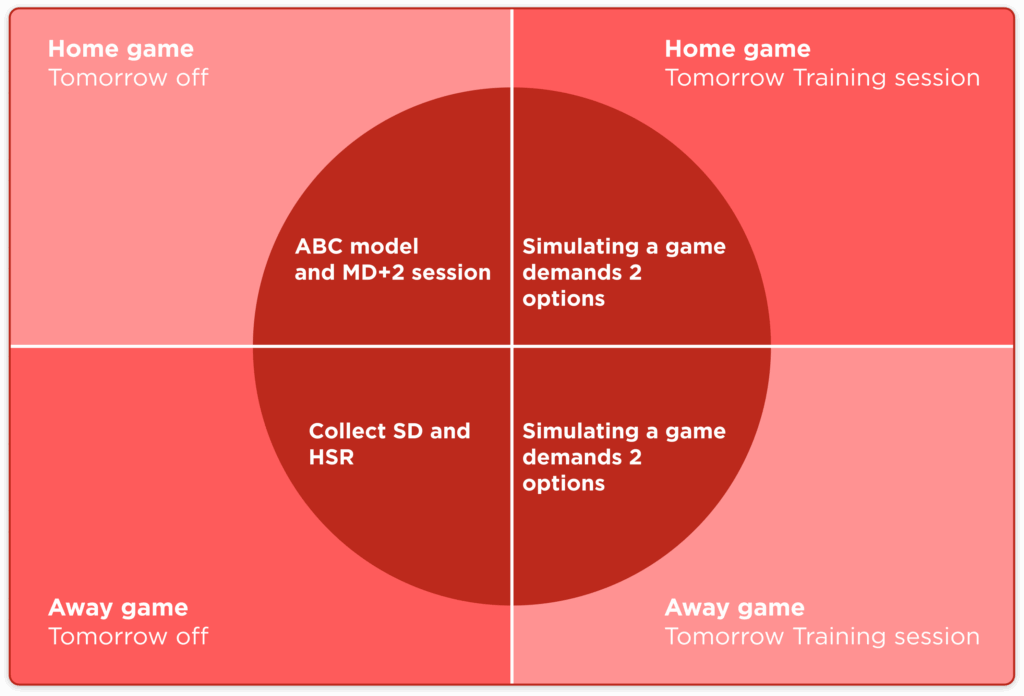
In football, the decision is always contextual. Match minutes, travel, the next-day schedule, pitch access, and the time until the next match dictate what you can do. This is exactly why the ABC decision framework is useful. It reduces the problem to two questions .
First, was the match at home or away? Second, is tomorrow an off day or a training day? Once those constraints are clear, you choose the simplest solution that still protects the essentials, maintaining match readiness for non-starters through peak exposures and enough weekly completeness. Buchheit outlines a clear post-match split between starters and substitutes, where starters prioritise recovery while substitutes and low-minute players require compensatory strategies to maintain preparedness.
The same paper reinforces that microcycle decisions are shaped by minutes played and practical constraints, and it presents scenario-dependent solutions rather than a one-size-fits-all prescription (Buchheit et al., 2024). It also supports a scheduling rule that maps directly onto this quadrants, when MD+1 is a rest day, compensatory load is commonly postponed to MD+2, whereas when MD+1 is a training day, compensatory work is typically delivered earlier and may be distributed across more than one day if needed. Further provides example session structures for these situations, effectively offering “plug-and-play” templates that match the logic of your model (Matušinskij, 2023).
In the home game, tomorrow off scenario, the framework naturally pushes the compensatory load toward MD+2, because that is where you can most reliably deliver quality. This is the scenario where you can combine football context with protected speed exposure without rushing execution, and where you can avoid compromising the recovery process immediately after the match. In the home game, tomorrow training scenario, you often need to deliver compensation earlier because the microcycle moves quickly and the team session takes priority. When the match is away and tomorrow is off, the framework acknowledges a different limitation.
Travel frequently reduces time, space, and readiness to execute complex content, so the smartest decision is often to simplify the solution and “collect” the essential exposures with minimal waste. In these situations, the ABC model can rely on a very simple running progression that still delivers meaningful stimulus, athletes begin with 15 seconds of easy jogging, then progressively increase speed to submaximal values based on subj secure high-intensity exposure without needing a complex football set-up or large numbers. ective feeling for 15 seconds, before completing 15 seconds of maximal exposure.
When the match is away and tomorrow is a training day, the constraints are highest, and this is where compensation often becomes token or disappears completely. The ABC framework prevents that drift by shifting the objective from full replacement toward minimum effective dose, protecting match readiness without creating fatigue that damages the next training day or the next match. In this context, the same structure can be used as a micro-dose by reducing overall volume while still protecting the key element: a short, deliberate maximal exposure block that ensures non-starters do not go the entire week without touching match-relevant intensity.
Congested Weeks: From Compensation to Micro-Dosing and Final Thoughts
The moment compensation becomes most important is also the moment it becomes most difficult, congested schedules. When you have two matches in a week, the question is not whether non-starters “need” compensation in theory, but whether compensation can be delivered without damaging recovery, tactical quality, and readiness for the next match. The correct answer is rarely to fully stop compensating; instead, the strategy shifts from chasing volume to protecting the key exposures that prevent readiness decay.
This shift is not just a coaching preference, it is a simple consequence of how weekly load is distributed in congested periods. Rice and colleagues highlight that when fixture density increases, match play can account for most weekly high-speed stimuli, in some cases representing more than 95% of a squad’s weekly sprint and high-speed running exposure. If a player does not play, the week can pass with almost no true speed stimulus. They also emphasise that typical post-match top-ups often only partially replace what the match provides, with high-speed and sprint contributions commonly remaining well below match values.
This is why, in congested weeks, compensation cannot be treated as a single session that “solves the problem.” It must be a weekly strategy designed to ensure that low-minute players still touch the exposures that matter most. (Rice et al., 2024). In a two-match week, match minutes become the first decision point. If a player accumulates meaningful minutes across both matches, the gap between match exposure and weekly exposure naturally shrinks, and the need for an additional top-up becomes minimal. For those players, the role of “compensation” turns into maintenance.
The goal is to keep the player feeling fresh while ensuring they do not go a full week without any speed or maximal-action exposure. This is why the most practical congested week solution is micro-dosing. It is a targeted method of delivering a minimum effective dose of the most valuable stimuli, typically sprint or HSR exposure and a small number of high-intent accelerations and decelerations, with minimal fatigue cost. It recognises the reality that in congested weeks, recovery and availability are priorities, and that “compensation” must fit around the purpose of the microcycle rather than compete with it.
This logic is consistent with a microcycle view of elite football periodisation, where training content is shaped by the need to maintain freshness while still delivering critical stimuli (Buchheit, 2024). A more robust approach is to keep decision-making simple. In congested weeks, starters usually need recovery and tactical preparation, while low-minute players need compensation. That protection is best achieved by ensuring that across the week, those players accumulate at least some meaningful exposure to speed and maximal actions, even if volume targets are modest. This is also consistent with longer monitoring work showing that teams who manage non-starters effectively often adjust training exposure to narrow the gap, reflected in higher training-to-match ratios for those players (Oliveira et al., 2023).
A practical way to end this discussion is to define what “good” looks like in the simplest terms. In a congested week, successful compensation does not mean recreating a full match. It means that the non-starter leaves the week with enough weekly work to avoid chronic underloading. The final takeaway is that compensation is not a single session. The ABC model helps you choose the right solution under real constraints, and micro-dosing gives you a safe way to maintain readiness during congested schedules.
Referenzen:
- Buchheit, M. (2024). Microcycle Periodization in Elite Football. Sport Performance & Science Reports, 218.
- Bortnik, L., Nir, O., Forbes, N., Alexander, J., Harper, D., Bruce-Low, S., Carling, C., & Rhodes, D. (2024). Worst case scenarios in soccer training and competition: Analysis of playing position, congested periods, and substitutes. Research Quarterly for Exercise and Sport, 95(3), 588–600. doi:10.1080/02701367.2023.2290265
- Casamichana, D., Barba, E., Aguirre, G., Agirrezabalaga, O., & Castellano, J. (2024). Compensatory training sessions, do they really compensate? International Journal of Sports Science & Coaching, 20(1), 152–158. doi:10.1177/17479541241287914
- Oliveira, R., Canário-Lemos, R., Morgans, R., Rafael-Moreira, T., Vilaça-Alves, J., & Brito, J. P. (2023). Are non-starters accumulating enough load compared with starters? Examining load, wellness, and training/match ratios of a European professional soccer team. BMC Sports Science, Medicine and Rehabilitation, 15, 129. doi:10.1186/s13102-023-00743-y