
What Is Velocity-Based Training?
Velocity-Based Training (VBT) is a method of approach in which movement velocity is used to guide, monitor, or adjust the training process. Weakley et al. (2021) define VBT as a method that uses velocity to “inform or enhance training practice.” This definition is important because VBT should not be viewed only as the use of a bar-speed device. Rather, it is a method of using objective velocity data to support decisions around feedback, loading, strength assessment, fatigue management, and programming.
In traditional resistance training, intensity is commonly prescribed using a percentage of one-repetition maximum (%1RM) or Reps in reserve (RIR). Although this method is widely used, it has practical limitations. An athlete’s 1RM can change across a training cycle, meaning that a load prescribed from a previous 1RM test may no longer represent the intended relative intensity. In addition, athletes can differ substantially in the number of repetitions they can complete at the same %1RM, so the same prescription may produce different levels of effort and fatigue between individuals (Weakley et al., 2021).
VBT attempts to address these limitations by using movement velocity as an additional indicator of training intensity and performance status. Since lifting velocity decreases as external load increases, the load velocity relationship can provide useful information about how demanding a given load is for the athlete. Velocity is also sensitive to fatigue, as fatigue accumulates, voluntary movement velocity tends to decline (Weakley et al., 2021).
A useful distinction in this context is the difference between load, effort, and exertion. Jovanović and Flanagan (2014) define load as the external resistance being lifted, usually expressed relative to 1RM. Effort refers to the athlete’s intention to move the load with maximal acceleration and speed during the concentric phase. Exertion refers to the proximity of the set to failure, often described practically as the number of repetitions left in reserve.
This distinction is central to understanding VBT. Two athletes may lift the same absolute load, but the physiological and neuromuscular demand of that lift may differ depending on their maximal strength, readiness, technical execution, and proximity to failure. By measuring velocity, coaches can gain additional information about the quality of the repetition and the training stimulus being imposed.
Why Velocity Matters: Load, Fatigue, and Feedback
The practical value of VBT comes from the relationship between movement velocity, training intensity, fatigue, and athlete intent. As external load increases, concentric velocity decreases. This load velocity relationship is one of the main reasons velocitiy can be used to estimate relative intensity and guide training prescription (Weakley et al., 2021).
Velocity is also closely related to fatigue. As fatigue develops during resistance or exsplosivnes training, the athlete’s ability to produce force and maintain contraction speed decreases. This is reflected in a progressive reduction in movement velocity across repetitions. Therefore, monitoring velocity during a set can help identify when the quality of work is declining and when the athlete is accumulating fatigue (Weakley et al., 2021).
Another important role of velocity is feedback. Real-time velocity feedback allows the athlete to see whether they are actually producing the intended movement speed. This is especially relevant because maximal intent is a key part of strength and power training. Jovanović and Flanagan (2014) emphasize that both the intention to move the load with maximal effort and the actual movement velocity are important training stimuli.
Weakley et al. (2021) also report that visual or verbal feedback of barbell velocity can improve acute performance, motivation, and competitiveness. Feedback after individual repetitions may be particularly useful because it gives the athlete immediate information about rep quality and encourages consistent intent across the set.
However, velocity feedback should be used with the goal of the exercise in mind. If the purpose of the movement is maximal force or speed, velocity feedback can be highly useful. If the goal is technical control, stability, range of motion, or early-stage rehabilitation, chasing higher velocity may be inappropriate. In those cases, movement quality should remain the priority.
Overall, velocity matters because it gives coaches objective information about three key aspects of training, how heavy the load is relative to the athlete, how fatigue is developing, and whether the athlete is applying the intended level of effort.
Creating a Load–Velocity Profile
A load velocity profile is one of the most practical starting points for applying VBT. It describes the relationship between the load an athlete lifts and the velocity at which that load is moved. This relationship allows coaches to better understand how an athlete performs across different loading zones, rather than relying only on a single 1RM value (Jovanović & Flanagan, 2014).
The profile should be created for a specific athlete and a specific exercise. A bench press profile cannot automatically be applied to the squat, and one athlete’s profile should not be assumed to represent another athlete’s profile. This is important because velocity characteristics can differ between exercises and between individuals, even when maximal strength appears similar.
For a squat load velocity profile, the first step is to standardize depth. The athlete should perform a 90-degree squat so the coach can identify the required depth for every repetition. This can be controlled in two simple ways. One option is to use a box set at the same height as the athlete’s 90-degree squat. Another option is to use a depth marker. To create the marker, the athlete lowers into the 90-degree squat position, and the coach marks the height of the top of the femur on a stick or similar reference point. During testing, the athlete must reach the same depth on every repetition.
After depth is standardized, the barbell is set on the rack at a comfortable height. The VBT device is attached to the bar according to the device’s instructions, and the athlete begins the testing protocol. The coach should observe technique throughout the test, especially depth, bar path, trunk position, and consistency of execution. Athlete feedback can also be collected after each load, such as how heavy the load feels or whether the movement feels normal. The velocity data then gives objective information to support that feedback.
Jovanović and Flanagan (2014) recommend developing a load–velocity profile by measuring mean concentric velocity across 4–6 increasing loads, usually ranging from 30–85% of actual or estimated 1RM. They also recommend at least 3 minutes of passive recovery between sets, so that fatigue does not strongly influence the velocity recorded at each load.
The fastest repetition at each load should be used to build the profile. This is important because the goal is to identify the athlete’s best velocity at each load, not the average of repetitions that may already be affected by fatigue.
Maximal intent is essential during the test. The athlete should attempt to move every repetition as fast as possible during the concentric phase, regardless of whether the load is light or heavy. Without maximal intent, the velocity data becomes less meaningful because slower speeds may reflect reduced effort rather than the actual relationship between load and performance.
Once velocity has been recorded across the selected loads, the coach can plot load on the x-axis and velocity on the y-axis. The result is a downward-sloping profile, lighter loads are moved at higher velocities, while heavier loads are moved at lower velocities. This profile can then be used to monitor progress, compare training responses, estimate strength changes, or guide future loading decisions.
Interpreting the Load–Velocity Profile
Creating a load–velocity profile is only useful if the data leads to better training decisions. The profile should not be viewed simply as a graph. Rather, it reflects how an athlete expresses strength across a range of loads and velocities.
A traditional 1RM test identifies the maximum load an athlete can lift once. A load–velocity profile provides a broader representation of performance because it shows how the athlete performs with lighter, moderate, and heavier loads. This is particularly important because two athletes can display a similar 1RM while showing clearly different velocity characteristics at submaximal loads.
Jovanović and Flanagan (2014) provide a practical example of this concept in two rugby players with a similar bench press of approximately 125 kg. Although their maximal strength was comparable, one athlete produced higher mean velocities across submaximal loads. As shown in Figure 3, Player 2 demonstrates consistently greater velocities at 60, 80, and 100 kg, despite both athletes showing similar performance at the heaviest load. This suggests that Player 2 possesses superior velocity characteristics, a difference that would not be identified from 1RM testing alone.
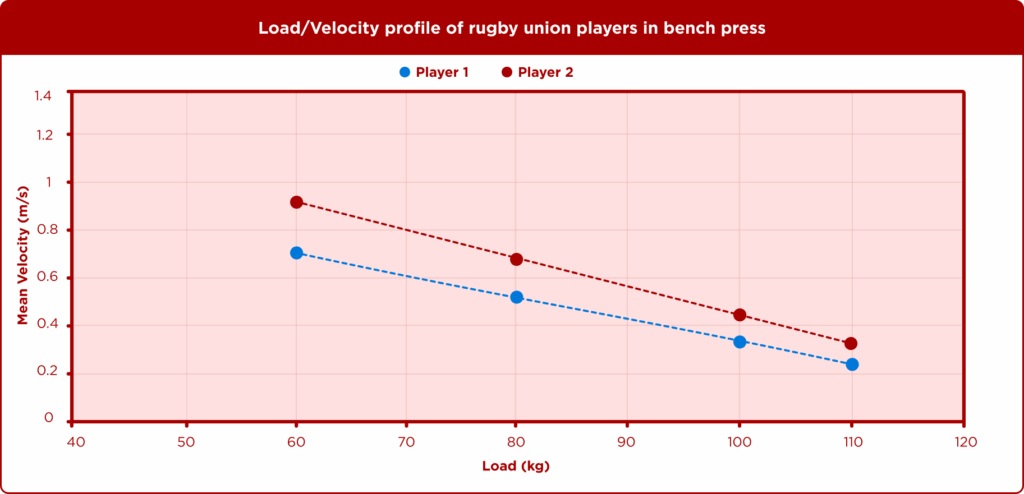
This example is important for coaches because it shows that maximal strength does not fully describe the athlete’s neuromuscular profile. One athlete may be relatively strong but slower across submaximal loads, whereas another may demonstrate greater velocity expression at the same relative intensities. These differences have direct implications for training prescription.
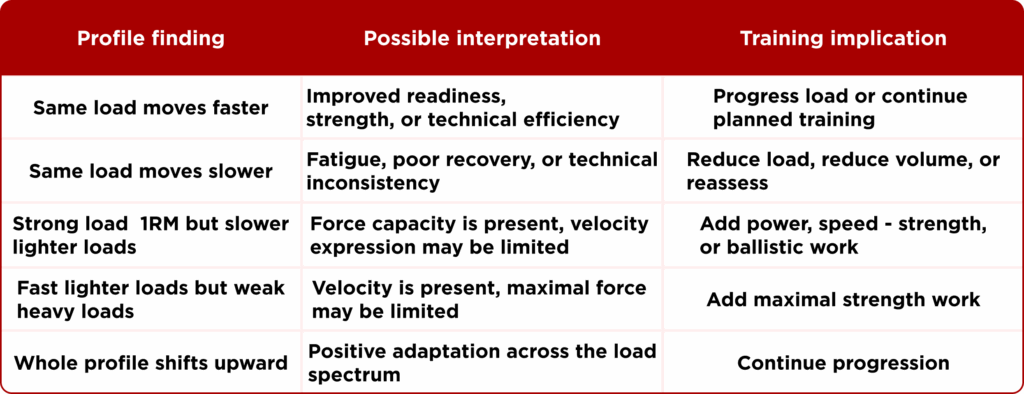
For example, an athlete who performs well at high loads but displays lower velocities at lighter and moderate loads may benefit from more velocity-oriented work. In contrast, an athlete who moves lighter loads quickly but shows lower performance as load increases may require greater emphasis on maximal strength development.
The load velocity profile can also be used to monitor adaptation over time. If an athlete moves the same load faster than before, this may indicate improved neuromuscular performance, increased strength, enhanced readiness, or improved technical efficiency. Conversely, lower velocity at the same load may indicate fatigue, reduced readiness, detraining, or technical inconsistency (Weakley et al., 2021).
However, small changes in velocity should be interpreted cautiously. Weakley et al. (2021) emphasize that coaches should account for normal day-to-day variation, measurement error, and the practical significance of any observed change. A small reduction or increase in velocity may not necessarily reflect a meaningful adaptation. Larger or repeated changes, particularly under standardized conditions, are more likely to be meaningful.
A practical way to interpret the profile is shown below:
Minimal Velocity Threshold and Estimated 1RM
Once a load–velocity profile has been created, one of its most common applications is estimating maximal strength without always performing a true maximal test. This is usually done by using the athlete’s relationship between load and velocity, together with the velocity associated with a maximal or near-maximal effort.
This point is often described as the minimal velocity threshold (MVT). Jovanović and Flanagan (2014) define MVT as the mean concentric velocity produced during the final successful repetition before failure, or during a successful 1RM attempt. In practical terms, it represents the slowest velocity at which an athlete can still complete a lift with maximal effort.
MVT is important because it appears to be exercise-specific. For example, Jovanović and Flanagan (2014) report approximate mean concentric velocities of around 0.15 m/s for the bench press and around 0.30 m/s for the squat. This means that a maximal bench press and a maximal squat should not be expected to occur at the same velocity. Each exercise has its own velocity characteristics.
The practical value of MVT is that it can help coaches estimate 1RM from submaximal loads. If the coach knows the athlete’s load–velocity relationship and the MVT for that exercise, the load associated with that minimal velocity can be estimated. This allows maximal strength to be monitored without always requiring a true 1RM test (Jovanović & Flanagan, 2014).
For example, if an athlete performs several submaximal bench press sets and the coach records the velocity at each load, those values can be used to create a regression line. If the athlete’s bench press MVT is known, the coach can estimate the load that would correspond to that velocity. This gives an estimated 1RM.
Weakley et al. (2021) also discuss this approach and recommend using mean velocity for 1RM prediction. Mean velocity is generally preferred because it tends to show a more stable and linear relationship with load compared with peak velocity, and it may vary less between measurement devices.
Velocity Zones and Velocity Loss
After the load velocity profile has been created and interpreted, velocity can be used to guide the actual training stimulus. In practice, this usually involves three connected ideas, velocity zones, velocity loss, and exertion.
Velocity zones help describe the type of physical quality being targeted. Heavier loads are generally moved at lower velocities and are more associated with maximal strength or high-force training. Lighter loads are moved at higher velocities and are more associated with speed, power, and explosive intent. However, these zones should not be treated as fixed universal categories. The velocity that represents a “heavy” or “power” zone can differ between exercises and athletes, which is why the individual load velocity profile is important.
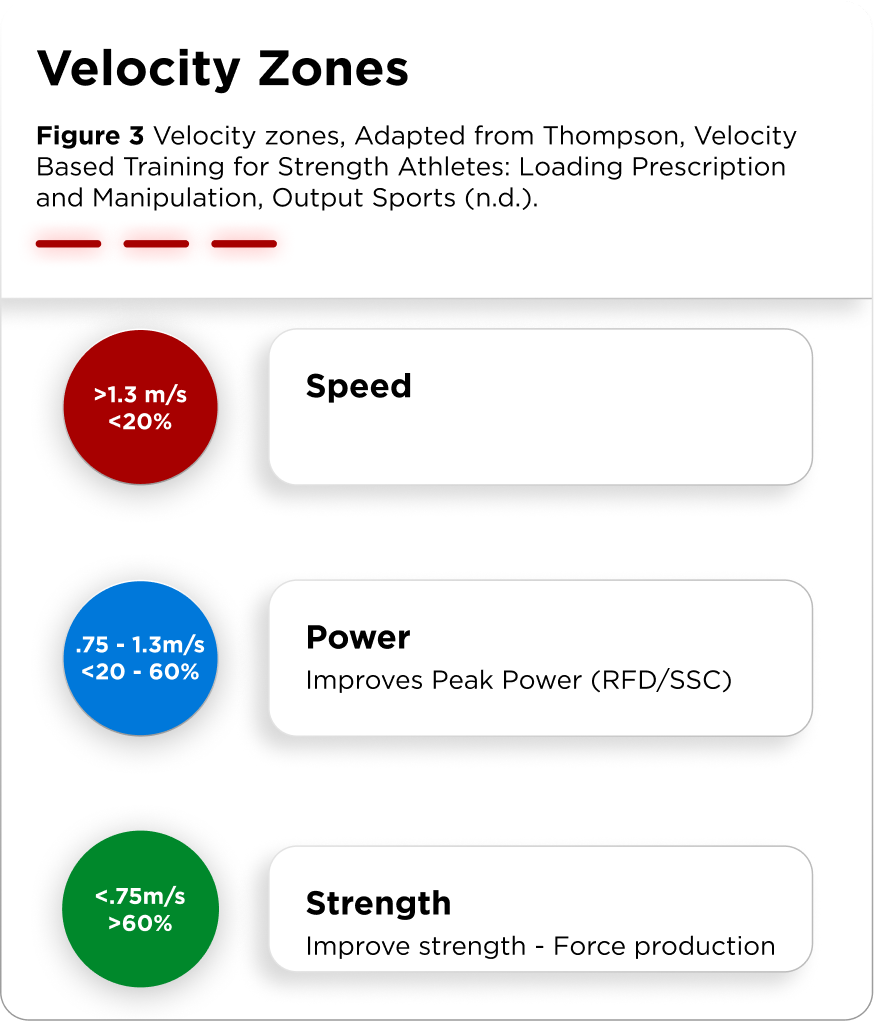
These zones are useful as a practical coaching guide, but they should not replace an individual load velocity profile. In a practical setting, velocity targets can help the coach decide whether the athlete is training the intended quality. For example, if the goal of a session is maximal strength, the athlete will generally train with heavier loads and lower movement velocities. If the goal is power or speed-strength, the load should allow the athlete to move with higher velocity and maintain high movement quality. Weakley et al. (2021) describe VBT to prescribe training using target velocities, velocity-loss thresholds, or a combination of both.
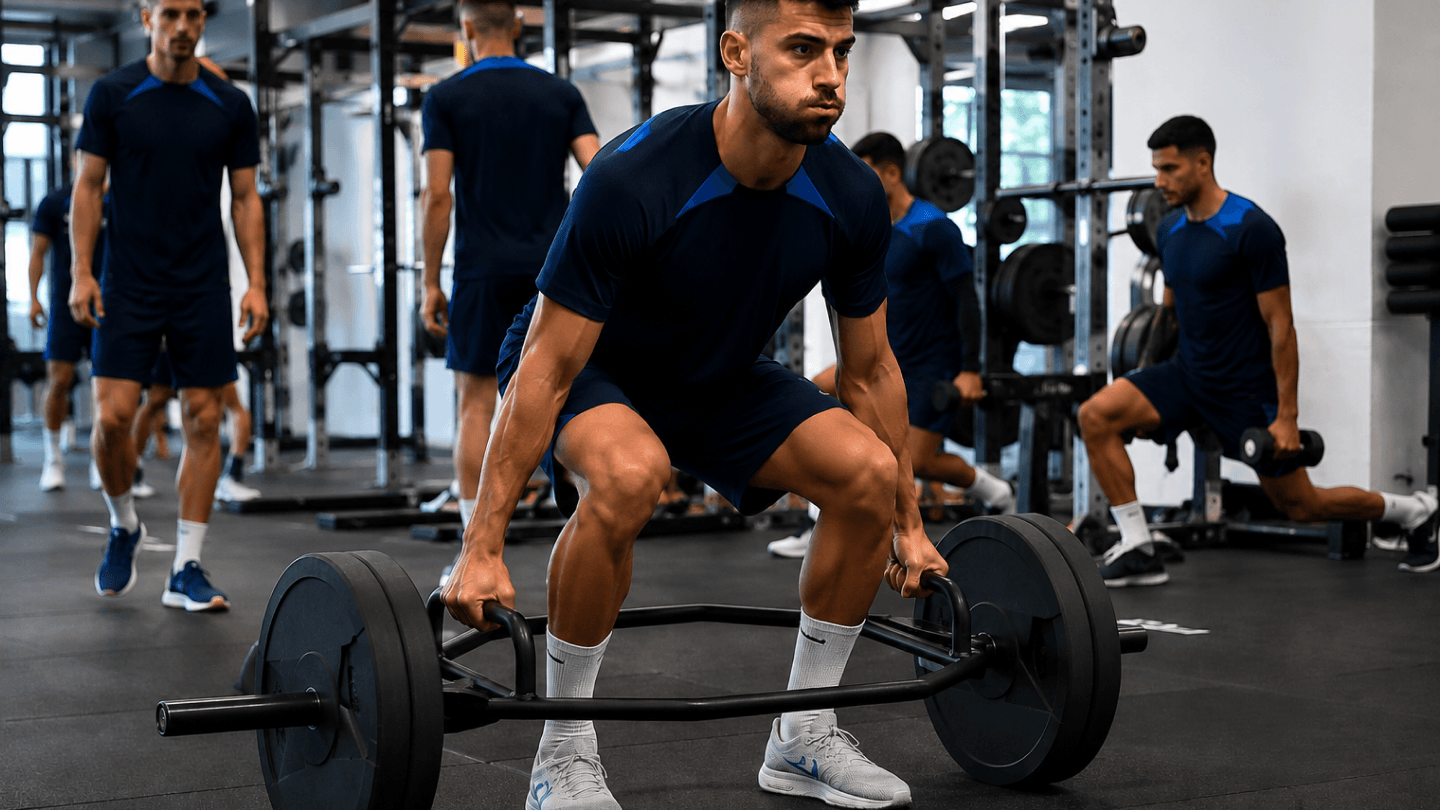
In the video example, the exercise goal is maximal strength. For that reason, the trap bar deadlift is performed with a heavier load and naturally lower movement velocity. The purpose is not to chase high bar speed in the same way we would during a ballistic exercise. Instead, velocity feedback is used to monitor the quality of each repetition and to control fatigue during the set.
In this example, velocity was monitored using the Enode VBT system, which provides real time feedback on each repetition. This allows the coach and athlete to see how the load is moving and how much velocity is being lost as the set progresses.
This is a practical example of how VBT can be used in heavy strength training. The goal is not always to move fast in absolute terms, but to use velocity feedback to understand how the athlete is responding to the load. For maximal strength work, lower velocities are expected, but large velocity losses can still indicate that the athlete is moving too close to failure or accumulating more fatigue than intended.
In this video example, the goal is explosiveness, not maximal strength.With this specific exercise, we are trying to use the eccentric phase effectively. The focus is on eccentric impulse and eccentric rate of force development, but without overloading the movement so much that the athlete loses speed. At the same time, we still want strong propulsive action, so the concentric phase is also important. We are looking for high concentric impulse, high concentric RFD, and an explosive transition into the upward phase.
Using the Enode VBT system, the main variables I was watching were time to peak power and velocity drop between repetitions. For this type of work, time to peak power is especially important because many sport actions happen in very short time windows, often under 200 ms.
Velocity drop was also monitored closely. For this exercise, I used a limit of around 5% velocity loss. The reason is that the goal of the exercise is not fatigue accumulation. The goal is to maintain explosive, high-quality repetitions. As fatigue builds across the set, each repetition becomes slower, and after a certain point the athlete is no longer training the same quality.
This is where VBT is very useful for explosive training. It helps confirm whether the athlete is still producing fast, repetitions or whether fatigue is starting to reduce the quality of the output. For maximal strength work, lower velocities are expected. But for explosiveness, we want to preserve speed, intent, and short time to peak power.
While velocity zones help guide what quality is being trained, velocity loss helps guide how much fatigue is being accumulated. Velocity loss refers to the drop in repetition velocity during a set. For example, if the first repetition of a squat is performed at 0.70 m/s and a later repetition is performed at 0.56 m/s, the athlete has experienced a 20% velocity loss. Different velocity-loss thresholds can produce different training effects. Smaller losses, such as around 10%, are often used when the goal is to preserve, speed, and high-quality repetitions. Greater, such as around 20%, can be used when the goal is strength or hypertrophy. development with controlled fatigue. Weakley et al. (2021) explain that increasing velocity-loss thresholds is associated with greater fatigue responses, while smaller thresholds help maintain velocity and power output.
This is important because movement velocity naturally decreases as fatigue develops. Jovanović and Flanagan (2014) explain that repetition velocity slows during resistance training sets as fatigue accumulates, and that this decline can be used as a practical way to control fatigue and exertion. Sánchez-Medina and González-Badillo (2011), cited by Jovanović and Flanagan, also showed strong relationships between velocity loss and metabolic fatigue markers such as lactate and ammonia. Velocity loss can therefore be used as a stopping rule. Instead of prescribing only a fixed number of repetitions,
This approach is useful because athletes do not fatigue at the same rate. Two athletes may perform the same exercise with the same relative load, but one may lose velocity quickly while the other maintains velocity for longer.
VBT in Rehabilitation
Although VBT is often discussed in strength and performance settings, it also has important applications in rehabilitation. This is especially relevant after injuries such as anterior cruciate ligament reconstruction (ACLR), where the aim is not only to restore strength, but to restore the athlete’s ability to produce force at the velocities and movement demands required by their sport.
In the Aspetar ACL rehabilitation model, rehabilitation is described as an individualized, assessment-guided process. King (2023) outlines five key principles of “The Aspetar Way”, an individualized approach, assessment-guided rehabilitation, multidisciplinary team contribution, development of multiple physical qualities, and a focus on motor learning and development rather than simply completing exercises. This framework fits well with VBT because velocity-based information can help clinicians and coaches identify what physical qualities are still limited and how training should be progressed.
A central concept in velocity-based rehabilitation is the force velocity profile. Samozino and Picot (2023) explain that maximal power (Pmax) combines force and velocity into one value, but it does not show whether the athlete is limited more by force production at low velocities or by force production at high velocities. This distinction is important because F0 and V0 are independent: being strong at low velocity is not the same as being strong at high velocity. Two athletes may show the same Pmax, or even the same jump height, while having different force–velocity profiles (Samozino & Picot, 2023).
For rehabilitation, this has direct consequences. If an athlete has a deficit on the force side of the profile, the program may need to emphasize maximal strength and high-force work. If the athlete has a deficit on the velocity side, the program may need to include more high-velocity actions.
In rehabilitation, what we often see is that strength starts to come back, but the bigger problem is the athlete’s ability to express high velocities. An athlete may improve in controlled gym-based exercises, but still struggle when the task becomes faster, more explosive, or more sport-specific. This is especially important because sport does not only require force production, it requires force production under time pressure. Sprinting, jumping, cutting, braking, and re-accelerating all demand the ability to produce force quickly. So, in the later stages of rehab, we should not only ask whether the athlete is strong again, but whether they can express velocities fast enough for the demands of their sport.
Samozino and Picot (2023) also emphasize that force-production capacities and adaptations are velocity-dependent. The structural and neuromuscular factors underlying force production at low velocity and high velocity are not the same. Therefore, both testing and training after ACLR should distinguish between force production at different velocities. A rehabilitation program that improves slow strength may not fully restore the athlete’s ability to produce force quickly.
This expands the role of VBT beyond the weight room. In the gym, velocity may be measured through barbell speed or loaded movement velocity. On the field, similar principles can be applied through sprint velocity, acceleration-speed profiling, or force–velocity-power profiling. The underlying question remains the same: can the athlete produce force at the speed and in the context required by the sport?
This is also why return to sport should not be viewed as a single moment. Taberner et al. (2020) argue that “return to function” may not be sufficient for elite athletes and that rehabilitation should progress toward return to performance. They emphasize the use of objective tools to quantify load and monitor the athlete’s response, while also recognizing that performance may only fully return after exposure to training and competition. In this context, VBT can be one part of a broader monitoring system that helps determine whether the athlete is regaining the physical qualities needed for performance.
The main value of VBT in rehabilitation is that it supports a needs-based progression. Instead of progressing only because a certain number of weeks have passed, the clinician and coach can use objective velocity-based information to decide what the athlete needs next. In this way, VBT can help connect gym-based strength training, power development, sprint progression, and return-to-performance decision-making.
Referenzen
Forelli, F., Riera, J., Marine, P., Gaspar, M., Memain, G., Miraglia, N., Nielsen–Le Roux, M., Bouzekraoui Alaoui, I., Kakavas, G., Hewett, T. E., King, E., & Rambaud, A. J. M. (2024). Implementing velocity-based training to optimize return to sprint after anterior cruciate ligament reconstruction in soccer players: A clinical commentary. International Journal of Sports Physical Therapy, 19(3), 355–365.
Jovanović, M., & Flanagan, E. P. (2014). Researched applications of velocity based strength training. Journal of Australian Strength and Conditioning, 22(2), 58–69.
King, E. (2023). Rehabilitation after ACL reconstruction: The Aspetar Way. Aspetar Sports Medicine Journal, 12(Targeted Topic 29), 284–291.
Samozino, P., & Picot, B. (2023). Velocity-based rehabilitation after ACL reconstruction: Testing and training. Aspetar Sports Medicine Journal, 12(Targeted Topic 29), 332–337.
Sánchez-Medina, L., & González-Badillo, J. J. (2011). Velocity loss as an indicator of neuromuscular fatigue during resistance training. Medicine & Science in Sports & Exercise, 43(9), 1725–1734.
Taberner, M., van Dyk, N., Allen, T., Jain, N., Richter, C., Drust, B., Betancur, E., & Cohen, D. D. (2020). Physical preparation and return to performance of an elite female football player following ACL reconstruction: A journey to the FIFA Women’s World Cup. BMJ Open Sport & Exercise Medicine, 6, Article e000843.