

Causes
As young athletes are increasingly exposed to high training volumes and intensities, injury incidence has risen. In some sports, injury rates in youth players have even surpassed those of professionals. Hamstring injuries affect athletes worldwide and account for around 10% of all injuries in field-based sports. Among the most affected are youth football players. In youth male footballers, muscle strains represent approximately half of all lower-limb injuries, with hamstring strain injuries (31%) being the most common.
The link between high-speed running, sprinting, and hamstring injuries is well established. In football, hamstring strains are among the most frequent non-contact injuries, typically occurring during acceleration, maximal sprinting, or periods of late-game fatigue. Research indicates that hamstring strain injuries have increased by 20% over the last decade among elite male youth football players. At the academy level, in a squad of 20 players, the expected seasonal risk includes 4–5 muscle strains and around 1.5 musculotendinous ruptures. A further concern is the high re-injury rate, with approximately 12% of players suffering a recurrence after returning to training.
Injury rates are higher during matches than during training sessions. This is largely due to the greater intensity of actions—such as sprinting, accelerating, decelerating, and cutting—that are strongly associated with hamstring injury mechanisms. Incidence also increases with age group, with U16 players showing the highest injury burden. A plausible explanation is the recent rapid growth typical in this age category, leaving players temporarily musculoskeletal-immature and more vulnerable to severe, time-loss injuries.
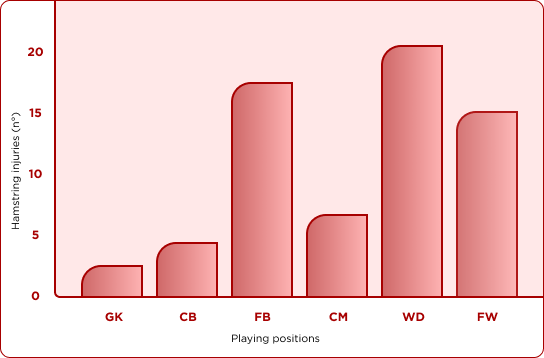
Certain positions—fullbacks, wide midfielders, and forwards—experience more hamstring injuries due to higher sprint demands. For this reason, position-specific load management is essential to reduce injury risk.
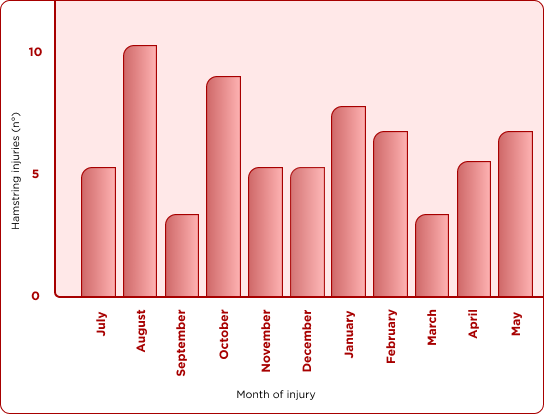
Seasonal trends show two incidence peaks:
• Pre-season (August), likely due to accumulated fatigue from intense training periods.
• Early in-season (October), probably linked to the physical stress of competitive matches.
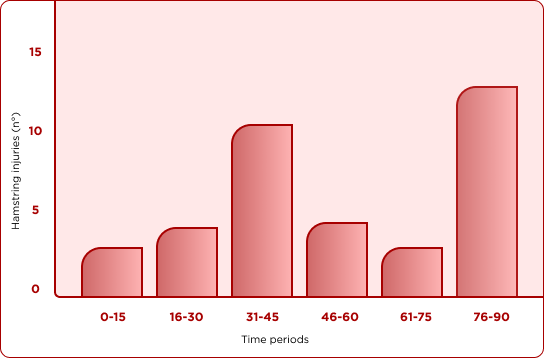
Additionally, young football players are more likely to sustain injuries during the final periods of matches (30–45 min and 75–90 min). Professional players are known to experience decreasing eccentric hamstring strength as a match progresses, increasing injury risk. This highlights the importance of developing fatigue tolerance in youth athletes through targeted training.
Preventive Strategies
Preventive efforts should be age-specific, with a strong focus on U18 players and consideration for U16 athletes who are still developing neuromuscular and musculoskeletal maturity. Preventive programs should also begin earlier—ideally around U14—to build adequate training age and technical competency.
Strength-training programs must target the specific demands of the hamstring muscles, using exercises that challenge them effectively. Long-term training is crucial. For example, short Nordic hamstring exercise blocks (3–4 weeks during pre-season) are unlikely to produce the structural adaptations needed for sustained protection. Consistency is essential.
A holistic injury-prevention approach should include:
• Eccentric hamstring strength exercises
• High-speed running exposure
• Acceleration and deceleration training
Recent findings show that hamstrings reach greater lengths and higher stretch speeds during acceleration from low running speeds than during steady maximal speed. This may explain why many hamstring injuries occur during acceleration. Therefore, proper running-technique training should be incorporated into the busy schedules of youth athletes.
Finally, rigorous training load control—adjusted to the physical demands of each playing position—is a fundamental requirement for reducing injury risk.
Wishing you success,
Igor Macner
Co-founder of Mozaiq Sports
Referencias
Álvarez-Ponce, D., & Guzmán-Muñoz, E.
(2018). Effects of a program of eccentric exercises on hamstrings in youth
soccer players. Universidad Santo Tomás & Universidad Finis Terrae.
Retrieved from
https://archivosdemedicinadeldeporte.com/articulos/upload/or03_alvarez_ponce_ingles.pdf
Kamdin, F. (n.d.). Hamstring injuries and
injury prevention strategies at elite male youth football academy level.
Sportsmith. Retrieved from
https://www.sportsmith.co/articles/hamstring-injuries-and-injury-prevention-strategies-at-elite-male-youth-football-academy-level/
Matušinskij, M. (n.d.). Revealing Nordic
Hamstring Test Results in Croatian Youth Football. Ultrax. Retrieved from
https://www.ultrax.ai/trainings/revealing-nordic-hamstring-test-results-in-croatian-youth-football/
Matušinskij, M. (n.d.). Using VALD Technology
in Football Teams – Part 4: NordBord. Ultrax. Retrieved from
https://www.ultrax.ai/trainings/using-vald-technology-in-football-teams-part-4-nordbord/
Raya-González, J., de Ste Croix, M., Read,
P., & Castillo, D. (2020). A longitudinal investigation of muscle injuries
in an elite Spanish male academy soccer club: A hamstring injuries approach.
Applied Sciences, 10(5), 1610. https://doi.org/10.3390/app10051610
Stanford Report. (2024, October 25).
Innovative techniques shed light on hamstring injury in athletes. Retrieved
from
https://news.stanford.edu/stories/2024/10/innovative-techniques-shed-light-on-hamstring-injury-in-athletes