Youth Physical Development
I think this was the first time in the last year or two that I experienced a real writer’s block. It was surprisingly hard to just put something on paper. Maybe I was simply busy with other things, but still – it took me a while to get started again.
Over the last few weeks, I had several conversations about how to build high-performance systems in clubs, and how to establish a structured physical development pathway for players across different age groups. These discussions brought me back to the very beginning of my coaching journey. I really enjoyed talking with different coaching profiles during these courses, from UEFA C and youth licensing programs to the UEFA Fitness course, where we opened many of these topics. It was interesting to see how coaches from different environments think about physical development and how differently clubs approach this process.
When I first started working in football, I worked mostly with younger categories, which is often the case in Croatia. I remember finding it both very interesting and very challenging. Working with young players opens a lot of questions. How much should they train? When should certain abilities be developed? What should be prioritized at different stages of growth? And maybe the most important question – how do you organize the process so that development actually progresses over time?
One of the resources that helped me a lot in understanding this topic was the book Strength and Conditioning for Young Athletes: Science and Application by Rhodri S. Lloyd and Jon L. Oliver (2013). I remember reading this book back in 2014, when I was working with a U12 group. At that time, many of the questions about youth physical development were still quite new to me. I was trying to understand how much we should train, how to structure sessions for young players, and when it is actually the right time to start introducing certain physical elements into training.This book really made me think. It gave me a lot of ideas and, maybe more importantly, a framework for approaching youth development in a more structured way.
Around that time, the authors were also publishing several papers on youth physical development, which helped clarify important questions, such as how to structure a training session for young athletes and when it is appropriate to start working on specific physical qualities.
Understanding the Youth Physical Development Model
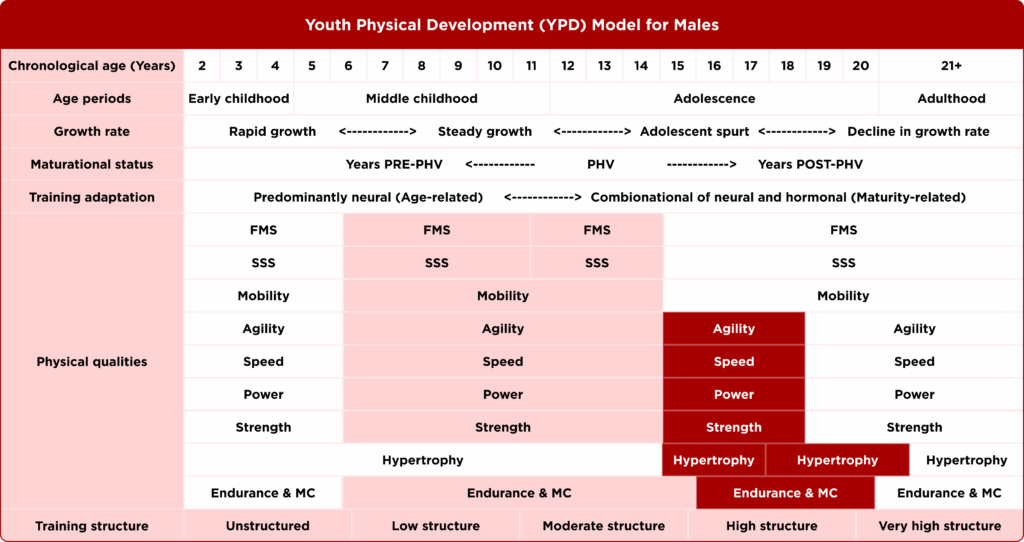
In their book Strength and Conditioning for Young Athletes: Science and Application, Lloyd and Oliver (2013) presented the Youth Physical Development (YPD) model. It provides a framework for understanding when and how different physical qualities should be developed throughout childhood and adolescence. At the time, this model introduced several important concepts that were not widely discussed in many football environments. One of the most important was the idea of biological age, rather than relying only on chronological age when planning training. The authors also highlighted the importance of Peak Height Velocity (PHV) and how growth and maturation influence training adaptations. ( i will talk about this next time).
Early Strength Development in Young Athletes
Another key point from this model was the recommendation to start working on strength earlier in the development of young athletes. For a long time, in many environments — including some clubs in Croatia, strength training was often misunderstood. It was frequently associated only with heavy weightlifting in the gym. Therefore, it was considered appropriate only for older players, usually after the age of 15 or 16.
Because of this perception, strength training sometimes carried a certain stigma in youth football.
However, our understanding has evolved significantly since then. Today, we know that multiple mechanisms drive strength development in young athletes, not only hormonal changes during adolescence. Early improvements in strength are largely related to neural adaptations, motor control, coordination, and movement efficiency. We also understand that the gym is simply a space, not a method. Many different approaches develop strength, including bodyweight exercises, medicine balls, resisted movements, jumps, games, and various forms of movement training.
Importantly, these types of training bring benefits beyond performance. They can contribute to better movement competence, improved bone and ligament health, enhanced neuromuscular control, and a lower risk of injury.
Progressive Development in Young Athletes
The YPD model helped shift the conversation from “when should we start strength training?” to a more relevant question: “How should we progressively develop physical qualities throughout childhood and adolescence?”
The Responsibility of Working with Young Athletes
Working with young athletes is a very serious responsibility. At this stage, we can easily miss important development opportunities if we do not organize the process well.
Windows of Opportunity in Youth Development
When discussing development phases, there has often been talk about “windows of opportunity.” This refers to the idea that certain physical qualities may be more trainable at specific ages. For example, we often suggest giving more attention to speed development before the age of 12.
A More Balanced Approach to Development
What I like about the model shown in the figure is that it presents a slightly more balanced perspective. Every quality is present throughout all stages of development. By “quality,” I mean movement skills, movement literacy, strength, speed, agility, mobility, endurance, and other motor abilities. However, the emphasis shifts across age groups. At certain stages we may focus more on one or two qualities, while at other stages the focus moves slightly in another direction. But importantly, none of these qualities completely disappear from the program.
When we think about a specific sport such as football, this becomes even more important. Young players are not only developing general physical abilities; they are also training and competing within their sport environment. Because of that, they still need exposure to all key physical qualities as they grow. In practice, this means that players will still work on speed, strength, movement skills, and endurance when they are 12, 14, or 16 years old. The difference is not whether we train these qualities or not , the difference lies in how we emphasize and structure them within the training process at different stages of development.
Educational Corner
Simple Progression Rule for Youth Academies When One Trains with Resistance
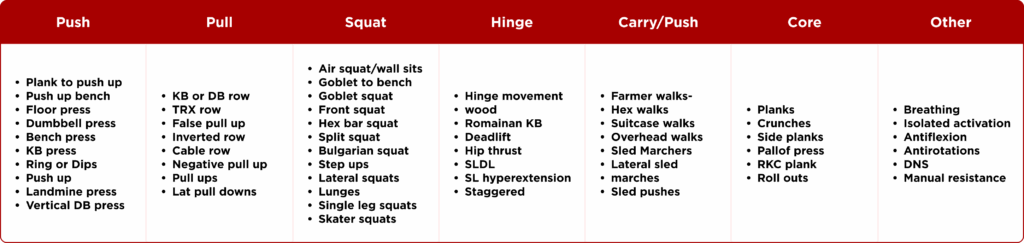
Pick one exercise from the box Stick with it for ~5 weeks.
- Progress gradually
Repetition progression
Week 1 → 2×8 Week 2 → 2×10 Week 3 → 2×12 Week 4 → 3×10 Week 5 → 3×12
- Then change the exercise
Time-based progression
3×10 sec 4×10 sec 5×10 sec 2×4×10 sec 2×5×10 sec
- Then change the exercise
What is really interesting today, with all the improvements in technology, is that we can finally start to understand what players are actually doing during training sessions and games. Tools such as GPS devices have opened a completely new perspective for coaches.
Have you ever analysed a U14 or U16 match using GPS data? Sometimes the results can be quite surprising. Even in games that last only 35 or 45 minutes, young players can reach quite demanding physical outputs.
You can see significant amounts of high-speed running, accelerations, decelerations, and total distance covered, which tells us that the game itself already provides a strong physical stimulus and they need to be ready also for that no matter sometimes the windows of development.
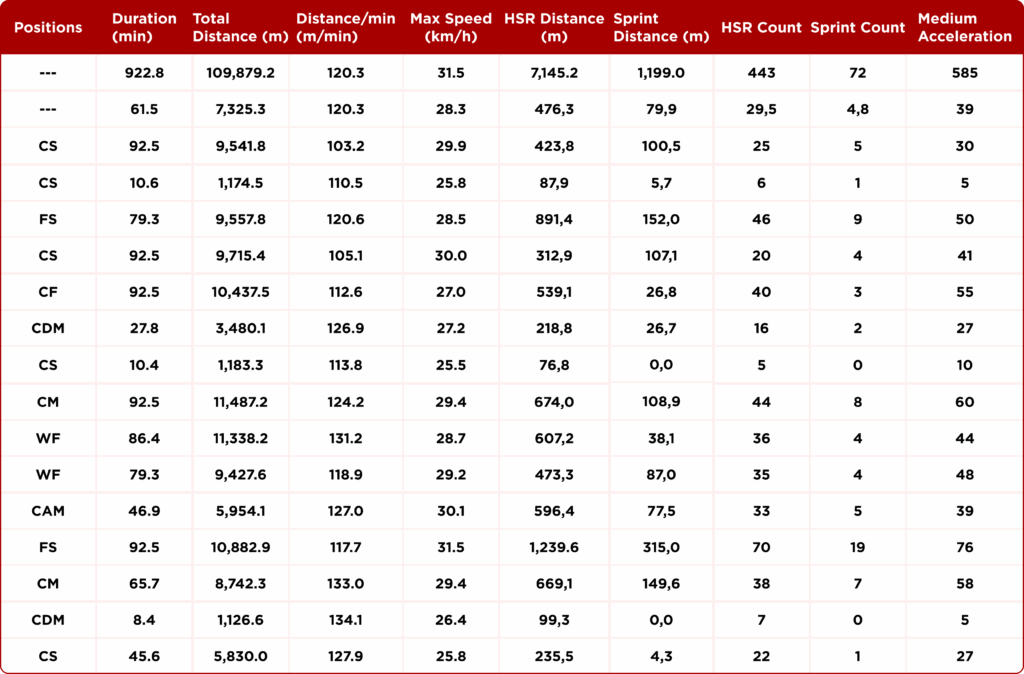
This is what a typical weekend can look like for a U15–U16 player during a match. And it is important to remember that these numbers are calculated using absolute speed zones, not individualized ones.
For example, in this dataset the high-speed running threshold is set at 19.8 km/h, which is the same value often used for senior players. This means that the actual demands could be slightly different if we used individual speed profiles, because some players might enter that zone earlier or later depending on their physical capabilities. This is where things can become a bit messy.
When you look at the demands of the game like this, it becomes quite clear that young players are already exposed to many different physical stresses during matches. They accelerate, decelerate, sprint, change direction, and perform repeated high-intensity actions. Because of that, we probably need to develop all of these qualities with them ,speed, agility, acceleration, braking, sprinting, and the ability to run at higher intensities regardless of whether we are talking about specific “windows of development”.
Players need to be prepared for the demands of the game they are already playing.
This is where the role of the strength and conditioning coach becomes extremely important. Our job is to build their capacity across all relevant physical qualities, while taking into account their chronological age, biological maturation, and individual physical profile.
Through regular testing and monitoring, we can start to understand where each player stands and how to progressively prepare them for the demands of football.
It is not an easy task. But alongside physical preparation, there is another important part of the process, physical education. Young players need to learn how to train, how to move well, and how to understand their own bodies. Because developing young athletes is not only about preparing them for the next game, it is about preparing them for long-term development and performance. Before moving into the concept of physical education within the academy environment, I want to mention something important: the difference between simulation and stimulation in training.
These days, I often see situations where young players are trained almost the same way as senior players. What I mean by that is that we sometimes copy senior microcycle structures and principles and apply them directly to younger age groups. In many cases, this leads to a type of simulation of match demands. For example, using GPS data we may say that if a player covers 10 km in a match, then across the week we should reach around twice that distance, maybe 20 km in total training load. But this approach can sometimes become just a replication of the game, rather than a real developmental stimulus.
Simulation simply reproduces what already happens in matches.
Stimulation, on the other hand, aims to provoke adaptation and development.
For example, if a player covers around 600 meters of high-speed running (HSR) during a match, it is quite easy to accumulate that amount across the training week through football drills or small-sided games. Sometimes even a short conditioning block, such as one set of 4 minutes of 15–15 intervals could already reach that number.
However, the real question is different.
What if that player needs to develop his aerobic capacity or to say increase the ability to recover between high-speed efforts?
In that case, simply simulating match demands is probably not enough. We need to create a stronger training stimulus.I remember that about nine years ago, in one club where I worked, we used strides with the U14 category not necessarily as a conditioning tool, but more as a way of educating the players. The goal was simply to introduce them to something they would likely experience the following year when they moved to the next age group.
We used longer rest intervals, keeping the intensity controlled, so that the players could understand the rhythm of the exercise and learn how to execute it properly. In that sense, the objective was not purely physical development, but rather preparing them for what comes next.And this is exactly where the concept of physical education within the academy environment becomes very important.
The concept of physical education within football academies is something I first heard discussed in more detail a few years ago by mister Des Ryan. His idea was quite simple but very powerful: players in different age categories should leave that stage of development with a certain level of physical competence.
In other words, by the time players finish a category, they should be able to demonstrate a set of exercises and movement patterns at a solid technical level. This shifts the focus slightly. It is not only about developing physical qualities such as strength, speed, or endurance, but also about teaching players how to move and how to train.
This approach combines physical development and education.
For example, by the time players reach the end of the U16 stage, they should be comfortable performing a number of fundamental exercises that form the basis for more advanced strength training later in their careers.
Key Movement Patterns Young Athletes Should Develop
Some of these competencies can include movements such as:
- Pulling patterns: assisted pull-ups, bent-over rows, TRX rows or inverted rows
- Pushing patterns: push-ups, overhead presses with light loads, bench press variations
- Squat patterns: BB squats, front squats or goblet squats
- Lunges and single-leg work: split squats, reverse lunges, lateral lunges
- Hip hinge movements: Romanian deadlifts, single-leg deadlifts, hip bridges
- Core and trunk stability: planks, chop and lift patterns, rotational exercises
- Carrying exercises: farmer carries or unilateral carries
The goal is not necessarily to lift heavy weights at this stage. Instead, the objective is to ensure that players understand the movements, control their bodies, and can execute exercises with good technique. This also prepares them for the next stage of development, where strength training can become more structured and progressive.
The Role of Fun in Youth Development
But it’s not only about structure and development models, there is also something very important that we sometimes forget: fun. After all, these are still kids. They need to enjoy being in your environment. They might stay in the club for several years, and having fun is often the reason why they joined football in the first place. At the same time, having fun does not mean that training cannot be meaningful. Through smart exercise selection, we can still work on universal movement skills while keeping sessions engaging and enjoyable.
One way to do this is by incorporating elements from different sports, especially with younger age groups such as U9–U12. These players are playing football, of course, but repeating the same movement patterns over and over again can sometimes increase injury risk and limit their overall motor development. Introducing elements from other sports can enrich their movement experience.
Now, some coaches might say: “Yes, but they are here to play football.”
And that is true. But it doesn’t mean they suddenly have to train handball or rugby for the whole session. Often it is simply a matter of how we structure the session.
- In one club where I worked as Head of Performance, we incorporated these elements into the weekly microcycle in a simple way. The structure looked something like this:
- First 10 minutes: work on physical qualities through fun activities and games
- Next 10 minutes: elements from different sports
- Then: the football training session
Across the week, we varied the focus:
- Monday: track and field elements, introducing specific movement skills that progressed from week 1 to week 4
- Tuesday: team sport elements such as handball, rugby, or volleyball
- Wednesday: elements from martial arts and gymnastics
If we manage to combine development, education and enjoyment in the training process, we are probably doing the right thing for the long-term development of young players.
If you’re interested in learning more about youth physical development and related topics, explore other articles on the Ultrax Science Hub.