Why We Feel Exhausted in a High-Performance World
Humans are the only species in the world that deliberately deprive themselves of sleep. People often think that things such as late-night scrolling, gaming, social media, long night television viewing, and any other extended work-related actions are more important than a biological need. On the other hand, many people do not get sufficient sleep due to more justifiable reasons, which can include many sleep disorders, work schedules, caregiving responsibilities, etc. Unfortunately, the loss of sleep always has negative consequences on the person, no matter the reason behind it. Despite overwhelming scientific evidence, sleep is still treated as optional and often overlooked, and underappreciated.
That creates a cascade of problems:
- low energy
- poor focus
- increased stress
- reduced performance
What Sleep Really Is
Luckily, there has been more interest in the past years in sleep and its influence on human life. Many people undervalue sleep because they are often not aware of its many physiological and cognitive benefits, starting even in the early stages of life, throughout childhood, and adolescence (Mason et al., 2021). Hence, there is a tendency in research to define and view sleep as a necessity for human optimal health and performance.
Defining sleep is far from easy. It is quite a complicated process, and its exact purpose remains an interesting topic for researchers. Brinkman et al. (2023) defined it as an active state of unconsciousness produced by the body where the brain is in a state of rest. Following this definition, sleep can also be described as a free and natural resource that allows us to regenerate and enhance numerous bodily and cognitive functions. It is an essential biological need. It can be argued based on recent research work that athletes depend on a good night of sleep that helps them learn new things. For instance, sleep plays a critical role in increasing the capacity for memory and learning by facilitating the formation of neural connections that support these processes (Brodt et al., 2023).
Importantly, not only the duration but also the quality of sleep is essential for ensuring optimal cognitive performance and recovery. Often, the cause of sports injuries is not overtraining, but insufficient recovery, usually caused by insufficient and poor-quality sleep. Both athletes and non-athletes often try to “catch up” on the lost sleep.
Unfortunately, as research indicates, this method is ineffective- “In terms of memory, then, sleep is not like the bank. You cannot accumulate a debt and hope to pay it off at a later point in time” (Walker, 2017). A review by Guzzetti & Banks (2022, p.5) similarly concludes that extending weekend sleep is insufficient in sleep health and cannot reimburse the loss that has been made. Despite its critical role in physical and mental health, sleep’s role in enhancing athletic performance is often overlooked.
Benefits of Sleep in Sport (and What Happnes Without It)
The available body of research focuses on a variety of topics regarding sleep, such as focus, concentration, injuries, etc. One brain function that buckles under even the smallest dose of sleep deprivation is concentration (Walker, 2017, p.139). It is known that concentration and focus play a key role in sports. Moreover, numerous studies have shown that sleep improves the motor skills of junior, amateur, and elite athletes across sports as diverse as tennis, basketball, football, soccer, and rowing (Walker, 2017, p. 132).
Similarly, Mah et al. (2011) demonstrated that basketball players who increased their nightly sleep to over 8 hours showed a 9% improvement in free-throw and 3-point shooting accuracy, and sprint performance improved by nearly 1 second. In swimmers, extended sleep led to improvements of about half a second in reaction times and overall swim performance. While such differences may seem small, they can be decisive in elite-level competition.
In a way that a good night of sleep helps athletes perform better, poor sleep is linked to an increased risk of injury. For example, a well-known study by Milewski et al. (2014) found that adolescent athletes who slept less than eight hours per night were 1.7 times more likely to sustain an injury compared to those who slept eight or more hours. In addition, the whole immune system, mood, and muscle recovery have been hypothesized to suffer after bad sleep (Fullagar et al., 2015).
Sleep is not just recovery- it is a performance enhancement.
Caffeine, Adenosine, and the Illusion of Energy
Athletes often use various substances to enhance their focus and performance throughout the day. One such substance is caffeine, which can be found in energy drinks, ice cream, chocolate, certain teas, and coffee. Caffeine is likely the most widely consumed psychoactive stimulant in the world. It can certainly help an athlete become or remain more alert and maintain better focus.
On the other hand, caution is necessary. In the brain, there is a chemical compound called adenosine that accumulates from the moment we wake up. The longer we stay awake, the more adenosine builds up. The result is the fatigue we feel, or the increasing desire to sleep. On average, after about 16 hours of wakefulness, we experience a strong urge to sleep.
Caffeine works by binding to the receptors that would normally be occupied by adenosine, effectively blocking and inactivating them. As a result, we no longer feel sleepy. In other words, it makes you feel more alert despite high levels of adenosine that would otherwise promote sleep. However, even when caffeine is present in the body, adenosine continues to accumulate in the brain.
Once the liver metabolizes the caffeine “barrier,” a strong rebound effect occurs, commonly referred to as a “caffeine crash.” You will then experience the drowsiness you felt a few hours before consuming caffeine, along with the additional adenosine that has accumulated in the meantime.
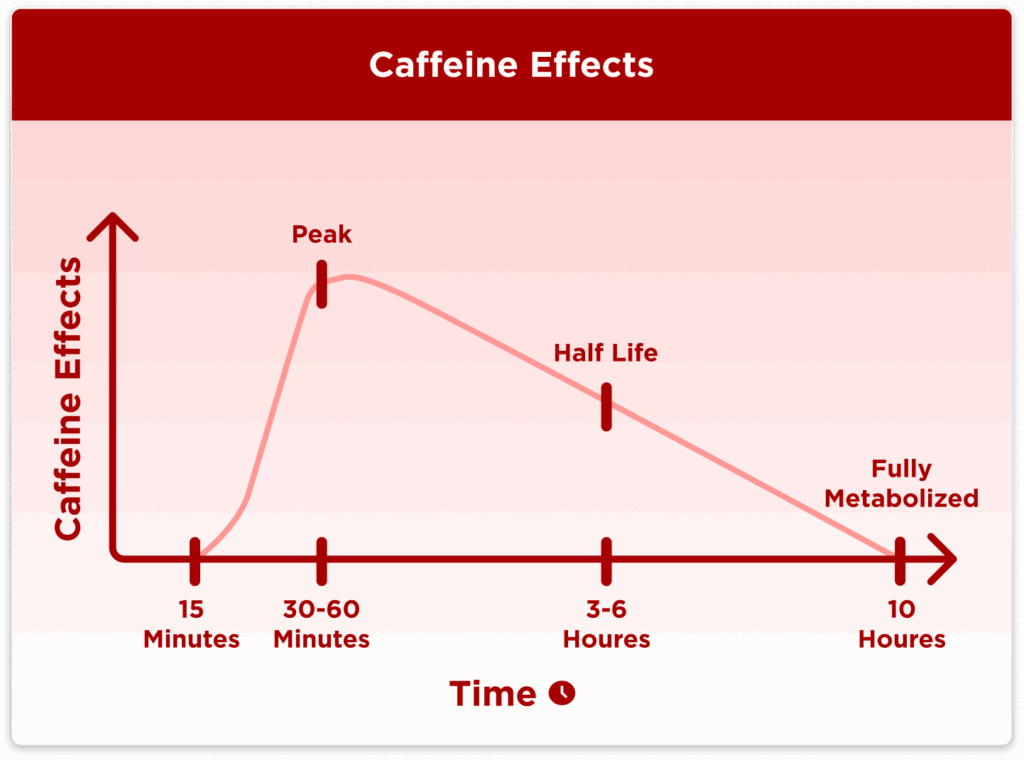
The issue arises during the withdrawal of caffeine from the body. On average, after 5–7 hours, about half of the caffeine is eliminated. This means that if, for example, you drink a cup of coffee at around 7 p.m., 50% of the caffeine remains active until approximately 1:30 a.m., continuing to circulate through brain tissue. In other words, by 1:30 a.m., you are only halfway through the process of clearing the caffeine consumed in the evening, which can significantly affect sleep quality.
For this reason, caution is warranted in caffeine consumption. According to general recommendations, caffeine should not be consumed at least 8–10 hours before bedtime. Additionally, consuming caffeine immediately upon waking may result in a caffeine crash in the early afternoon.
Cortisol: The Hormone of Energy (Not Just Stress)
Cortisol is commonly known as the “stress hormone”. When we hear the word stress, we tend to associate it immediately with something negative, which is why stress is often portrayed in a negative light. However, it can also be understood from a more mechanical perspective—namely, how to regulate its timing and how to use it to our advantage. Cortisol is secreted by the pituitary gland and can be viewed as an “energy hormone,” as it creates a physiological state in which you feel inclined to move, rather than rest, and initially suppresses the desire to eat. Its primary role is to increase energy.
We need cortisol. This may sound counterintuitive at first—how could we need a so-called stress hormone? Yet it plays a crucial role in the immune system, memory, regulation of blood glucose levels, blood pressure, and emotional regulation. We do not want cortisol levels to be too high, but neither should they be too low. The key is to control both the timing and the amount of cortisol release. It is particularly important to avoid elevated cortisol at inappropriate times of the day.
The question is not whether cortisol is simply good or bad, but rather how much, for how long, and at what time of day we want it to be elevated or reduced. Cortisol, inflammation, and stress are not inherently harmful in themselves.
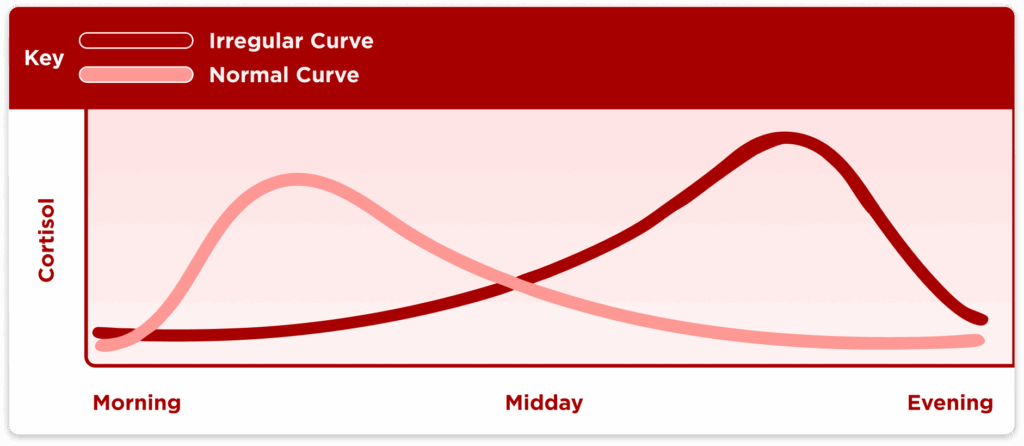
We often hear that it is important to lower cortisol in order to better cope with stress. While this is true, there is a level of cortisol that is adaptive and healthy. It is especially important for cortisol levels to be highest in the morning upon waking. Ideally, cortisol should peak in the morning compared to later in the day, as this indicates the ability to recover and disengage from stressors by the end of the day. In other words, for optimal health, cortisol should reach its peak approximately 30 minutes after waking and gradually decline throughout the afternoon and evening.
How to Regulate Cortisol and Energy
Unfortunately, we cannot afford the luxury of continuously lowering cortisol throughout the day. We should expect cortisol levels to rise in response to various challenging or unpleasant situations during the day—in other words, any form of stress. Interestingly, the body does not distinguish between stress caused by a message, an email, a cold shower, or any other stimulus. Even if you enjoy what you are doing, this does not change the fact that cortisol and epinephrine levels in your body will increase.
The key is that these increases in cortisol should be short-lived. Otherwise, we risk chronically elevated cortisol levels, which can lead to a prolonged state of heightened cortisol and result in numerous negative consequences, as mentioned earlier.
Tools supported by research and one of the leading neuroscientists in the world, Andrew Huberman, we can:
Increase alertness:
- cold exposure (cold showers)
- intense exercise
- breathing techniques
Regulate cortisol rhythm:
- morning sunlight exposure
- delay caffeine intake
- avoid late-night stressors
Sunlight and Circadian Rhythm
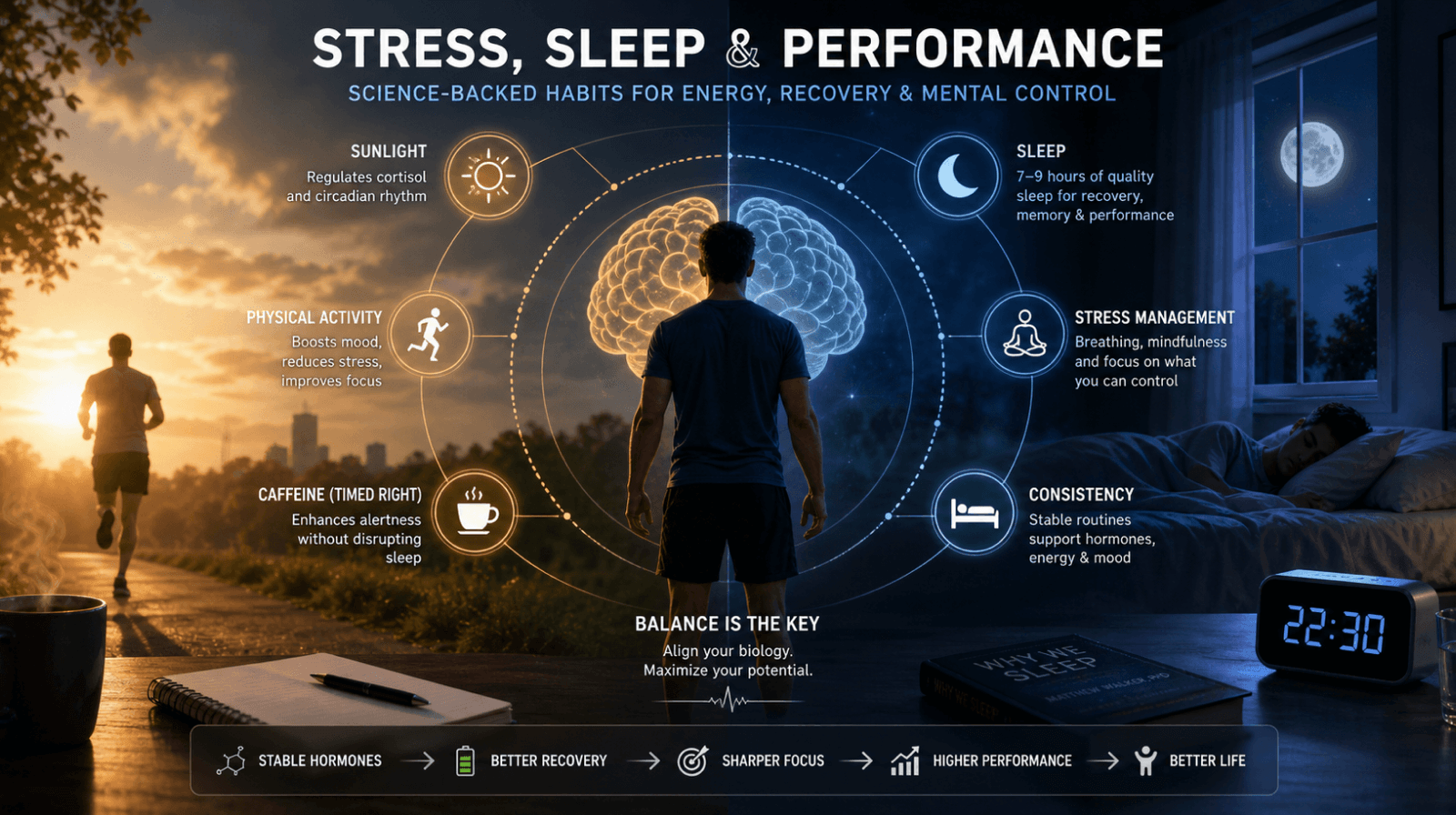
Circadian rhythm is a 24-hour biological cycle. It regulates: sleep, hormones, energy, and mood. According to the National Institute of General Medical Sciences, circadian rhythms are primarily controlled by light and darkness.
Morning sunlight:
- triggers cortisol release
- improves alertness
- enhances sleep later
Lack of sunlight leads to:
- disrupted sleep
- mood instability
Due to this reason, sunlight exposure and sleep are interconnected. Sunlight is one of the most effective ways to stimulate cortisol levels is to expose yourself to natural sunlight immediately after waking. This helps to “anchor” the cortisol peak early in the morning. Also, it is important to go to bed and wake up at the same time each day.
- Keep your room cool – a lower core body temperature supports better sleep.
- Avoid caffeine – particularly in the late afternoon and evening.
- Limit blue light exposure – avoid screens before bedtime to allow melatonin to accumulate naturally.
It is important to note that these factors can vary from person to person, and finding the right balance between caffeine consumption and sleep habits is essential. However, what is universal is that sleep is a non-negotiable biological necessity, so listen to your body and go to bed on time.
Practical Guidelines
Here are some practical guidelines for each of the categories mentioned above to have the most energy and focus throughout the day and best recovery throughout the night:
Sleep
- consistent schedule
- cool, dark room
- no screens before bed
Light
- 10–20 min morning sunlight
- If cloudy, turn on artificial lights
Caffeine
- avoid 8–10 hours before sleep
- delay it in the morning at least 90 minutes after waking up (drink some water first)
Performance
- prioritize recovery
- align work with energy peaks
- sleep go
Conclusion
Sleep serves as the foundation of human biology. It is during sleep that the brain reorganizes information, the body recovers, and the immune system strengthens. Without sufficient and high-quality sleep, every other system begins to lose efficiency, including focus, emotional regulation, and physical performance.
Cortisol, often misunderstood as purely harmful, plays a central role in this process. When properly timed, it enables wakefulness, energy, and readiness for action. However, when its rhythm is disrupted—whether through poor sleep, late-night stimulation, or chronic stress—it becomes one of the key drivers of fatigue and imbalance.
Caffeine, while useful in certain contexts, often masks underlying physiological fatigue rather than solving it. By interfering with adenosine signaling, it creates a temporary sense of alertness that can ultimately disrupt sleep and further destabilize the system if used improperly.
Taken together, these systems highlight a simple but often ignored truth: performance, health, and mental clarity are not achieved through isolated interventions, but through alignment with basic biological principles. When sleep, light exposure, and hormonal rhythms are properly synchronized, the body functions efficiently and sustainably. When they are not, no amount of external effort can fully compensate for that imbalance.
References:
Bobak, J. (2023, October 27). How long does caffeine stay in your system? (the whole truth). Home Grounds. https://www.homegrounds.co/how-long-does-caffeine-stay-in-your-system/
Brodt, S., Inostroza, M., Niethard, N., & Born, J. (2023). Sleep—A brain-state serving systems memory consolidation. Neuron, 111(7), 1050-1075. https://doi.org/10.1016/j.neuron.2023.03.005
Brinkman, J. E., Reddy, V., & Sharma, S. (2023, April 3). Physiology of sleep. In StatPearls. StatPearls Publishing. Retrieved from https://www.ncbi.nlm.nih.gov/books/NBK482512
Guzzetti, J. R., & Banks, S. (2022). Dynamics of recovery sleep from chronic sleep restriction. Sleep Advances, 4(1), Article zpac044. https://doi.org/10.1093/sleepadvances/zpac044
Mah, C. D., Mah, K. E., Kezirian, E. J., & Dement, W. C. (2011). The effects of sleep extension on the athletic performance of collegiate basketball players. Sleep, 34(7), 943–950. https://doi.org/10.5665/SLEEP.1132
Mason, G. M., Lokhandwala, S., Riggins, T., & Spencer, R. M. C. (2021). Sleep and human cognitive development. Sleep Medicine Reviews, 57, Article 101472. https://doi.org/10.1016/j.smrv.2021.101472
Milewski, M. D., Skaggs, D. L., Bishop, G. A., Pace, J. L., Ibrahim, D. A., Wren, T. A., &
Barzdukas, A. (2014). Chronic lack of sleep is associated with increased sports injuries in
adolescent athletes. Journal of Pediatric Orthopaedics, 34(2), 129–133.
https://doi.org/10.1097/BPO.0000000000000151
Medved, E. (2014, February 16). Huberman on biohacking your cortisol. SiPhox Health. https://siphoxhealth.com/hub/blog/huberman-on-biohacking-your-cortisol?srsltid=AfmBOordqBsi6tR1TrXEGswQWt4DKFxtw5vfBAQeyVUcGByf32MX_GgB
Walker, M. (2017). Why We Sleep: Unlocking the Power of Sleep and Dreams. Scribner